
Bird of the Month: Burrowing Owl
Burrowing Owl: A Grassland Original
It’s May, which means it’s time for one of the most exciting birding events in our region, the Pikes Peak Birding and Nature Festival. This year’s featured artwork highlights the charismatic, long-legged, ground-dwelling Burrowing Owl! With their bright yellow eyes, expressive faces, and habit of standing tall outside underground homes, these owls bring a whole new personality to what many people expect from an owl.
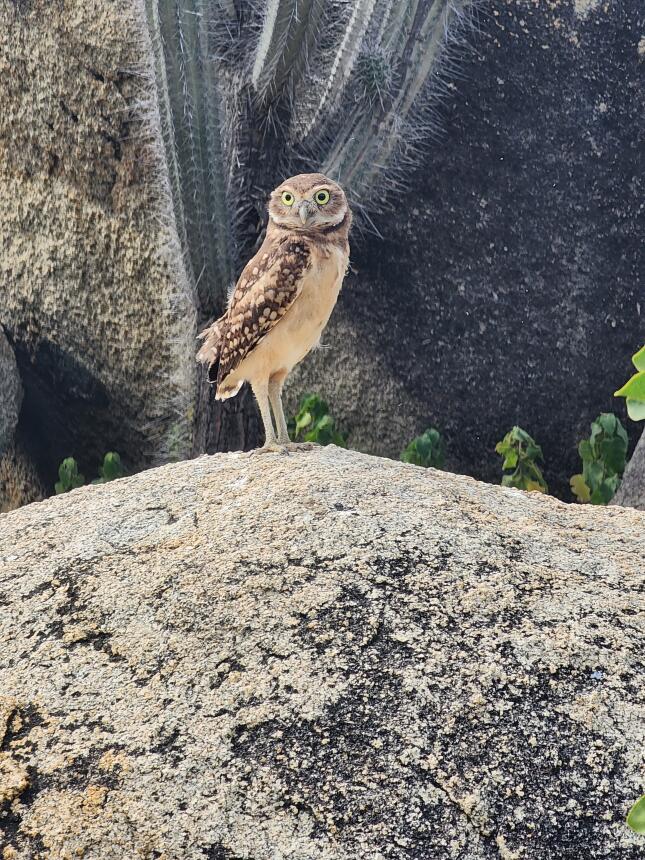
When most people picture an owl, they imagine a silent hunter perched high in a tree under cover of darkness. The Burrowing Owl flips that image entirely. These small, sandy-brown owls are creatures of the open prairie, active during the day as often as at night, and instead of nesting in trees, they live underground.
Burrowing Owls (Scientific Name: Athene cunicularia) are found throughout much of the Americas, from the grasslands of western North America down through Central and South America. Here in Colorado, they are primarily summer residents, arriving in spring to breed across the eastern plains and other open landscapes. Their choice as our Bird of the Month is especially fitting for May, when grasslands are coming alive and migratory birds are settling in for the breeding season.
At about 9–11 inches tall, Burrowing Owls are small as owls go, with long legs that give them an almost comical upright stance. Their plumage is mottled brown with white spotting, providing excellent camouflage against dry soils and grasses. Unlike many owls, they lack prominent ear tufts, and their flat facial disk gives them a wide-eyed, almost perpetually surprised expression.
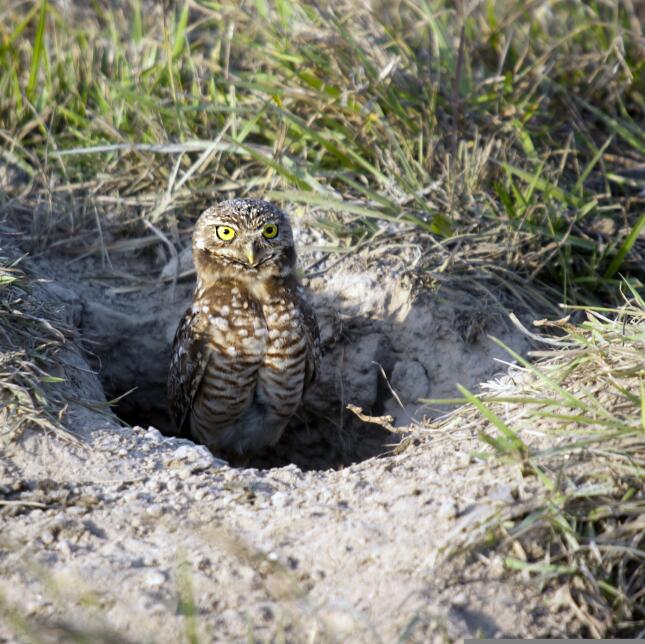
But what truly sets them apart is their lifestyle. These owls rely heavily on underground burrows, most often ones dug by mammals like prairie dogs, ground squirrels, or badgers. Rather than excavating their own homes, they are opportunistic tenants, adapting existing burrows into nesting sites and safe havens from predators and extreme weather.
Basic Information
Burrowing Owls belong to the genus Athene, which includes a few other small, ground-associated owls around the world. Their adaptability has allowed them to thrive in a range of open habitats, though they remain closely tied to ecosystems shaped by burrowing mammals.
They are highly expressive birds, often seen bobbing their heads, bowing, or making quick darting movements. These behaviors are thought to help them gauge distance and detect movement, especially in wide-open environments where cover is limited.
Their vocalizations are equally interesting. While they do produce traditional owl hoots and coos, they are also famous for mimicking the rattling sound of a snake when threatened in their burrows. This clever defense can deter predators who might think twice about reaching into a hole that sounds like it houses a rattlesnake!
Burrowing Owls are also surprisingly social compared to many other owls. While they are not colonial in the same way as some waterbirds, they often nest in loose clusters, particularly in areas with active prairie dog towns.
Habitat
Burrowing Owls are birds of open landscapes. They prefer short-grass prairies, deserts, agricultural fields, and other flat, sparsely vegetated areas where visibility is high and burrows are available. In Colorado, they are most often associated with prairie dog colonies. These colonies provide an abundance of ready-made burrows and an ecosystem rich in insect and small vertebrate prey. The relationship between Burrowing Owls and prairie dogs is a great example of how interconnected species can be. Prairie dogs are often considered a keystone species because their burrowing activities create habitat not just for owls, but for a wide variety of wildlife.
Burrowing Owls may also be found in human-modified environments such as airports, golf courses, and agricultural lands, as long as suitable burrows are present and disturbance is relatively low. In some regions, conservationists even install artificial burrows to help support populations.
Food Preferences
Despite their small size, Burrowing Owls are efficient and opportunistic hunters. Their diet is diverse and changes with the seasons. During the breeding season, insects make up a large portion of their diet. Beetles, grasshoppers, crickets, and other invertebrates are abundant in grassland habitats and provide an important food source, especially for growing chicks.
They also hunt small vertebrates, including rodents, lizards, and occasionally small birds. Their long legs allow them to run, hop, and even sprint after prey on the ground, a behavior that feels more like a shorebird than a typical owl. Burrowing Owls often hunt during the day, particularly at dawn and dusk, but they can be active at any time depending on food availability. They may perch on fence posts, low mounds, or even stand at the entrance of their burrow, scanning for movement.
One especially fascinating behavior is their tendency to store food. They may cache prey near their burrow, creating a reserve they can rely on when hunting conditions are less favorable.
Mating, Nesting, and Raising Young
Burrowing Owl courtship is charming and surprisingly elaborate. Males begin by selecting and preparing a burrow, often lining it with grasses, feathers, and sometimes even bits of manure. While that might sound odd, manure can actually help attract insects, providing an easy food source right outside the nest.
Males perform a variety of displays to attract a mate, including wing-spreading, bowing, and offering food. Vocalizations play an important role as well, with soft cooing calls exchanged between potential partners.
Once a pair bond is established, the female lays a clutch of typically 6–12 eggs, though clutch size can vary depending on food availability and environmental conditions. The eggs are incubated for about 3–4 weeks, primarily by the female, while the male provides food.
After hatching, the chicks remain in the burrow for the first couple of weeks of life. During this time, they are completely dependent on their parents. As they grow, they begin to venture to the entrance of the burrow, peeking out at the world and practicing their coordination. Fledging occurs at around 4–6 weeks of age, but even after leaving the burrow, young owls often stay nearby and continue to rely on their parents for food and protection for several more weeks. Family groups can be quite active and entertaining to watch, with multiple young owls bobbing, hopping, and interacting around the burrow entrance.
Tips for Spotting Burrowing Owls
Finding a Burrowing Owl can feel like a treasure hunt, but once you know what to look for, your chances improve dramatically!
Start by looking in the right habitat. Open grasslands, especially areas with active prairie dog colonies, are your best bet. Scan for small, upright shapes on the ground or perched on low objects like fence posts. East of Colorado Springs in places like Hanover Road on the way to Chicho Basin Ranch are great places to start,
Early morning and evening are often the most active times, though Burrowing Owls can be seen throughout the day. Bring binoculars and take your time. Their camouflage can make them blend into the landscape until they move. One helpful clue is the presence of whitewash or small pellets near a burrow entrance. These signs can indicate an active owl site. If you do find a Burrowing Owl, it’s important to keep a respectful distance, especially during the breeding season. Disturbance can cause adults to abandon a nest or expose chicks to predators.
Conservation Concerns
Despite their adaptability, Burrowing Owls face a number of conservation challenges.
Habitat loss is one of the most significant threats. Grasslands across North America have been heavily altered by agriculture, development, and other land uses. As these habitats disappear, so do the burrows and prey species that owls depend on. The decline of prairie dog populations also has a direct impact. Efforts to control or eradicate prairie dogs reduce the availability of suitable nesting sites, creating a ripple effect throughout the ecosystem. Burrowing Owls are also vulnerable to pesticide use, which can reduce insect populations and introduce toxins into the food chain. Vehicle collisions and predation by domestic animals can also pose risks, particularly in more developed areas.
In many parts of their range, Burrowing Owls are considered a species of conservation concern. Efforts to protect them often focus on preserving grassland habitats, supporting prairie dog colonies, and installing artificial burrows where natural ones are scarce. Organizations and community members can make a real difference by advocating for habitat protection and practicing bird-friendly land management.
A Grassland Ambassador
The Burrowing Owl is more than just a fascinating bird. It’s a symbol of the prairie ecosystem and a reminder of how interconnected species truly are. From prairie dogs to insects to wide-open landscapes, this owl helps tell a story of balance and adaptation.
As we celebrate the Pikes Peak Birding and Nature Festival this May, keep an eye out for this year’s featured bird. Whether you spot one standing sentinel at the entrance to its burrow or watch a family of young owls exploring the world for the first time, it’s an experience you won’t soon forget!